




Sustainability is becoming more important for companies and consumers. One key topic in sustainability is the Recyclatanteil, also called recycled content. This means how much recycled material is used in a product or its packaging.
Many people know about recycling. But recycling alone is not enough. If companies do not use recycled materials in new products, recycling systems do not work well. The Recyclatanteil helps to close this loop. It shows how much recycled material goes back into new products. This is a big part of the circular economy.
This article explains Recyclatanteil in simple words. It uses lists and tables to make the topic easy to understand.
1. What Is Recyclatanteil?
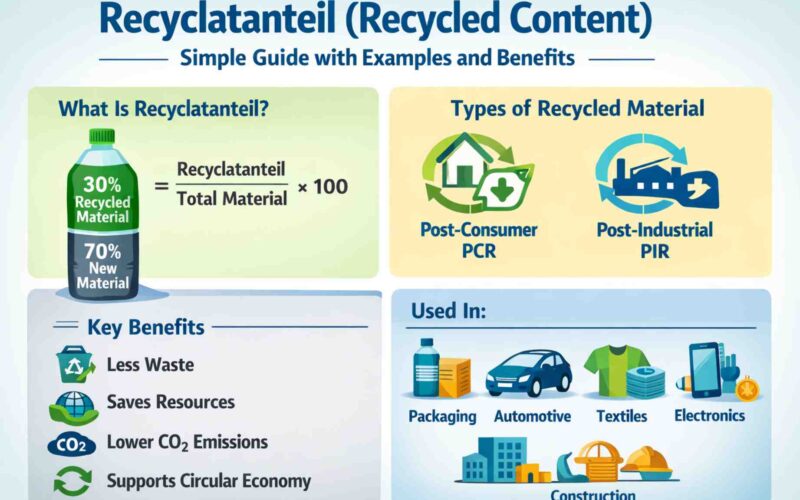
Recyclatanteil means the percentage of recycled material in a product or package.
Key Points
-
It is shown as a percentage (%)
-
It is usually measured by weight
-
It can apply to:
-
Plastic products
-
Paper and cardboard
-
Metal products
-
Glass products
-
Textile products
-
Simple Example
-
A bottle is made of:
-
70% new plastic
-
30% recycled plastic
-
-
The Recyclatanteil is 30%
2. Recyclatanteil vs. Other Similar Terms
People often mix up different recycling terms. This table shows the difference:
| Term | What It Means |
|---|---|
| Recyclatanteil | How much recycled material is in a product |
| Recycling rate | How much waste is recycled |
| Recyclability | If a product can be recycled |
Important:
A product can be recyclable but still have 0% recycled material inside.
3. How Is Recyclatanteil Calculated?
Simple Formula
-
Recyclatanteil (%) = (Recycled material ÷ Total material) × 100
Example Table
| Item | Value |
|---|---|
| Total product weight | 100 g |
| Recycled material weight | 20 g |
| Recyclatanteil | 20% |
What Companies Need to Do
-
Measure materials by weight
-
Keep records from suppliers
-
Be honest and clear about numbers
Read also: Hybrid Cars Are Taking Over the Market
4. Types of Recycled Material
There are two main types of recycled material.
Main Types
-
Post-Consumer Recycled (PCR)
-
Comes from used products
-
Example: used plastic bottles
-
-
Post-Industrial Recycled (PIR)
-
Comes from factory waste
-
Example: plastic waste from production
-
Comparison Table
| Point | PCR (From Users) | PIR (From Factories) |
|---|---|---|
| Source | Household waste | Factory waste |
| Environmental value | Very high | Medium |
| Quality | Can change | More stable |
| Supply | Often limited | More stable |
5. Why Is Recyclatanteil Important?
Environmental Benefits
-
Uses fewer natural resources
-
Saves energy
-
Reduces CO₂ emissions
-
Creates less waste
Business Benefits
-
Less need for new raw materials
-
More stable supply of materials
-
Better image for the company
-
Helps meet laws and rules
Benefits for Society
-
Supports recycling systems
-
Creates green jobs
-
Helps protect nature
6. Where Is Recyclatanteil Used?
Recycled content is used in many industries.
| Industry | Examples of Use |
|---|---|
| Packaging | Bottles, food packs, boxes |
| Consumer goods | Cleaning bottles, furniture |
| Cars | Interior parts, fabrics |
| Construction | Pipes, panels, insulation |
| Textiles | Clothes made from recycled plastic |
| Electronics | Plastic housings, cables |
7. Laws and Rules (Simple Overview)
Many countries now ask companies to use more recycled material, especially in packaging.
Common Rules
-
Minimum recycled content for packaging
-
Special safety rules for food packaging
-
Proof and reports about material sources
Simple Table
| Area | What Companies Must Do |
|---|---|
| Packaging | Use a minimum amount of recyclate |
| Food packaging | Follow strong safety rules |
| Reporting | Show proof of recycled content |
| Market access | Follow rules to sell products |
8. How Is Recyclatanteil Checked?
Companies must prove their recycled content.
Common Methods
-
Get data from suppliers
-
Use tracking systems
-
Use third-party checks
-
Use certification systems
Why This Is Important
-
Stops false green claims
-
Builds trust with customers
-
Helps follow laws
-
Makes reports more reliable
9. Challenges and Problems
Using more recycled material is good, but not always easy.
Main Challenges
-
Not enough high-quality recycled material
-
Recycled materials may have different quality
-
Costs can be higher
-
Some products need very clean materials
-
Supply chains can be complex
Read also: Do the Driving Modes in the Cadillac LYRIQ Change Range or Battery Use?
Simple Trade-Off Table
| Goal | Possible Problem |
|---|---|
| High recycled content | Lower material strength |
| Low cost | Recycled material may cost more |
| Food safety | Hard to get safe recycled input |
| Nice product design | Fewer design choices |
10. How Companies Can Increase Recyclatanteil
Practical Steps
-
Design products that are easy to recycle
-
Use fewer different materials
-
Work with recycling suppliers
-
Set clear targets for recycled content
-
Train design and buying teams
-
Start with small changes and grow
11. Future of Recyclatanteil
The use of recycled materials will grow in the future.
What to Expect
-
Stronger laws and rules
-
Better recycling technology
-
More recycled materials on the market
-
More tracking of materials
-
More demand from customers
Future Trends (List)
-
New recycling methods
-
Better sorting of waste
-
More transparent supply chains
-
More recycled content in products
12. Quick Questions and Answers
| Question | Simple Answer |
|---|---|
| Is more recycled content always better? | Not always. Quality and safety also matter. |
| Can recycled material be used for food packs? | Yes, but only with strict safety rules. |
| How do companies prove recycled content? | With documents, checks, and certificates. |
| Is recyclable the same as recycled? | No. Recyclable means it can be recycled. Recycled means it already is. |
Final Message
The Recyclatanteil shows how serious a company is about sustainability. It helps save resources, reduce waste, and support the circular economy. While there are challenges, using more recycled material is one of the most real and practical ways to protect the environment. Companies that start early will be better prepared for future laws, customer needs, and sustainability goals.