




Most office cleanouts happen at the worst possible time. A lease is ending in three weeks. A renovation is starting Monday. A building sale just closed. Suddenly there are filing cabinets from 2009, broken chairs stacked in a back hallway, outdated electronics piled in a storage room, and nobody is quite sure who owns any of it.
The pressure to clear space fast is real, but the idea that you need to shut everything down to do it properly is a misconception. With the right approach, commercial junk removal can happen around your people, your hours, and your workflow, without disrupting a single client call or missing a deadline.
Here is how to make it work.
Start With a Space Audit Before Anything Gets Scheduled
The biggest mistake businesses make is calling a hauler before they know what they actually have. An audit does not need to be elaborate. Walk each area of the space with a notepad or your phone and categorize what you see into three buckets:
- Keep and relocate (items moving to another floor, storage unit, or new location)
- Donate or resell (furniture, working electronics, shelving units)
- Remove and dispose (broken items, outdated tech, general debris)
This step matters because it directly affects the scope of the job. A crew arriving to a space that has already been sorted works significantly faster than one arriving to an undifferentiated pile. It also prevents usable assets from accidentally being hauled away, which happens more often than most office managers expect.
If your space is large or multi-floor, consider assigning a point person per zone. That person makes the keep/remove call on ambiguous items and keeps the process moving.
Decide What Requires Specialized Disposal
Commercial spaces accumulate materials that cannot simply go into a dumpster. Before scheduling any removal, identify whether your cleanout involves:
- Electronics and IT equipment (computers, monitors, servers, printers)
- Fluorescent lighting or ballasts
- Office appliances (refrigerators, microwaves, water dispensers)
- Shredded document waste or confidential paper
- Batteries and toner cartridges
E-waste in particular is regulated. In New York State, the Electronic Equipment Recycling and Reuse Act prohibits businesses from disposing of covered electronic devices in standard trash. Working with a commercial junk removal company that understands responsible disposal, rather than one that simply loads and hauls, matters here.
For confidential documents, verify whether your cleanout team handles paper removal or whether you need a separate secure shredding service before the haul.
Schedule Around Your Operations, Not Around Theirs
This is where a lot of cleanouts go wrong. Businesses assume the crew needs full access to the entire space for an entire day. That is rarely true.
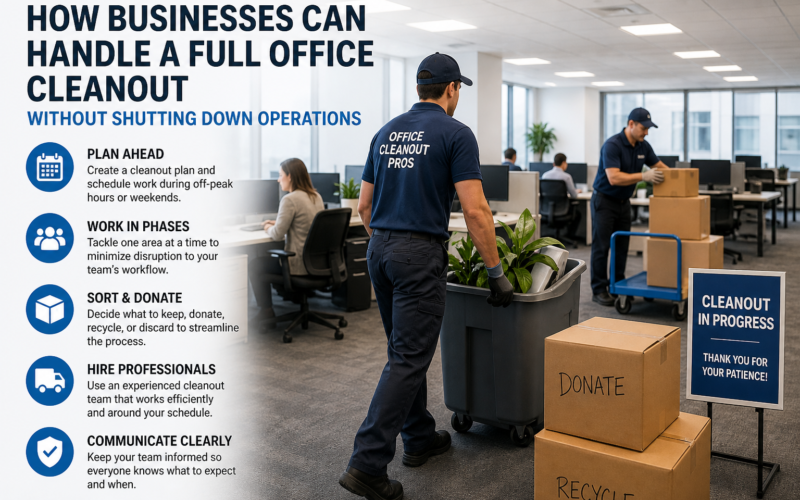
A well-coordinated commercial cleanout can happen in phases:
- Phase 1 (after hours or weekend): Remove large furniture, appliances, and debris from common areas and storage rooms where staff do not work
- Phase 2 (low-traffic windows): Clear individual offices during lunch hours or early mornings, one section at a time
- Phase 3 (final sweep): Once the space is mostly cleared, do a full walkthrough to collect stragglers
This phased approach is especially useful for businesses that are renovating in place, relocating floor by floor, or preparing a partial section of a building for a new tenant while the rest stays operational.
Talk to your removal team about what windows work and what access points are available. Freight elevators, loading docks, and parking logistics all affect scheduling. A crew that regularly handles commercial jobs will be used to working around these constraints.
Handle Furniture With a Plan, Not an Afterthought
Office furniture is bulky, heavy, and often the last thing that gets dealt with. Desks, filing cabinets, modular cubicle systems, ergonomic chairs, and conference tables can all pile up quickly once a clearout begins.
A few things worth knowing:
- Many charitable organizations and school resale programs accept office furniture in good condition. Habitat for Humanity ReStores, for instance, take certain furniture items, and local nonprofits often need desks and chairs badly.
- Modular cubicle systems are time-consuming to disassemble. If they are being donated, confirm the recipient can accept them in that form. If they are being removed, make sure the team is equipped to break them down.
- Metal filing cabinets often have scrap metal value and may be diverted from landfill by a responsible hauler.
Furniture that cannot be donated or recycled still needs to go somewhere. Building that into the removal budget upfront prevents surprises.
Coordinate With Your Property Manager Early
Whether you own the building or lease it, your property manager needs to know a cleanout is happening. This is less about permission and more about logistics: loading dock availability, elevator reservations, parking for a haul vehicle, and building-specific rules about what can move through which exits.
Some commercial leases include specific requirements about how the space must be left, including whether built-in shelving or fixtures need to be removed. Missing those details can affect your security deposit or complicate a property handover.
If you are a property manager handling a tenant turnover, the same logic applies in reverse. Having a reliable office cleanout service on call for end-of-lease situations means you are not scrambling when a tenant leaves a space in poor condition. A fast, professional team can clear a floor quickly and get it ready for the next occupant without weeks of delays.
What to Look for When Hiring a Commercial Removal Team
Not every junk removal company has experience working in commercial environments. A residential-focused crew may be perfectly competent, but commercial jobs have different variables: higher volumes, multiple floors, elevator logistics, the need to work quietly around active staff, and stricter requirements around responsible disposal.
When evaluating a provider, ask:
- Do they carry general liability insurance? (Non-negotiable for any commercial property)
- Can they work outside of standard business hours?
- How do they handle electronics and regulated materials?
- Do they provide itemized pricing or charge by volume?
- Can they provide references from similar commercial jobs?
Teams like Morse Hauling & Junk Removal that are fully insured and experienced with commercial environments understand that an office cleanout is not just about moving boxes. It is about protecting the property, working around real business constraints, and disposing of materials responsibly.
The Donation and Diversion Angle
Responsible disposal is not just good ethics, it is increasingly a practical consideration for businesses managing their environmental footprint. Many commercial clients now require documentation that waste was diverted appropriately, especially for furniture and electronics.
Before everything goes to landfill, it is worth identifying what can be donated. Local nonprofits, thrift chains, schools, and community organizations often welcome office supplies, working electronics, and furniture in usable condition. Some will arrange pickup for larger quantities.
A commercial junk removal team worth hiring should be sorting for diversion, not just loading everything into a truck. Ask upfront how they handle items that could be donated or recycled.
Key Takeaways
- Audit the space before scheduling removal. Knowing what stays, what gets donated, and what gets hauled saves time and prevents costly mistakes.
- Phase the cleanout around your business hours so operations stay uninterrupted. Large commercial spaces rarely need to go dark for a full day.
- Electronics, lighting, and other regulated materials need more than a standard haul. Make sure your removal team handles them responsibly.
- Coordinate with building management early, especially around loading dock access, elevator reservations, and lease-end requirements.
- Ask removal teams the right questions upfront: insurance, hours, disposal practices, and commercial experience are the four that matter most.
FAQ
How long does a commercial office cleanout typically take? It depends heavily on the size of the space and how sorted the items are before the crew arrives. A single-floor office that has been pre-sorted might take a few hours. A multi-floor space with decades of accumulated items could take a full day or be broken into multiple visits. Getting an on-site estimate before committing to a schedule is worth the time.
Can a commercial cleanout happen without the whole office knowing? Yes, though some coordination with staff is usually helpful. If items in personal work areas are being cleared, employees should be notified in advance. Cleanouts in common areas, storage rooms, and vacant sections can often happen with minimal disruption, especially if scheduled during low-traffic periods.
What happens to office electronics during a commercial junk removal? This varies by company. Responsible haulers will route covered electronic devices to certified e-waste recyclers rather than standard landfill. If electronics are a significant part of your cleanout, ask the removal team directly how they handle them before booking.
Do we need to be present for the entire cleanout? Not necessarily. Most commercial cleanouts run smoothly with a designated point person available by phone, even if they are not on-site continuously. For spaces with access restrictions or complex logistics, having someone present for at least the first hour helps set the crew up correctly.
What if we find items we want to donate but do not have time to organize pickups? Some junk removal companies will sort for donation during the haul and handle drop-off themselves. It is worth asking upfront whether this is included or available as an add-on. Alternatively, reach out to local nonprofits a week or two before the cleanout to give them time to arrange a pickup before the removal crew arrives.
Closing Thoughts
A commercial cleanout is a logistical project, not a crisis. The businesses that handle them well treat them that way: plan the space first, schedule in phases, confirm disposal practices, and loop in the right people early.
The goal is a clean slate for whatever comes next, whether that is a new office layout, an incoming tenant, or simply a workspace that functions better. None of that requires shutting down. It just requires a clear plan and a team that has done this before.