




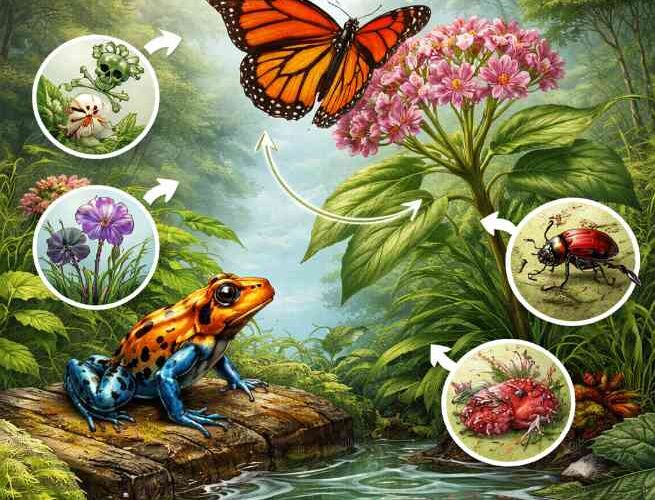
Nature is full of interesting ways that animals survive and protect themselves. Some animals run fast, some hide well, and others use poison to defend themselves. One unusual survival strategy is called kleptotoxicity.
The word kleptotoxicity comes from two Greek words:
-
Klepto – meaning to steal
-
Toxicity – meaning poison
So, kleptotoxicity means stealing poison. In this process, some animals take toxic chemicals from plants or other animals and store them in their bodies. They do not make the poison themselves. Instead, they get it from their food or environment and use it as protection. This strategy helps many animals survive because predators learn to avoid them. Scientists study kleptotoxicity to understand how toxins move through ecosystems and how animals adapt to their environments.
What is Kleptotoxicity?
Kleptotoxicity is when an organism gets poison from another source and uses it for defense.
Instead of producing toxins inside their bodies, these animals take toxins from plants, insects, or other prey.
Key Features of Kleptotoxicity
-
The animal does not produce the toxin itself.
-
The toxin is taken from food or environment.
-
The toxin is stored inside the body.
-
The toxin helps protect the animal from predators.
Comparison: Producing Poison vs Stealing Poison
| Feature | Animals That Produce Poison | Animals Using Kleptotoxicity |
|---|---|---|
| Source of toxin | Produced inside body | Taken from other organisms |
| Energy use | High | Lower |
| Purpose | Defense or hunting | Mostly defense |
| Example | Snakes, spiders | Monarch butterflies, poison frogs |
How Kleptotoxicity Works
Kleptotoxicity usually happens in three main steps.
-
Getting the toxin
-
Storing the toxin
-
Using the toxin for defense
1. Getting the Toxin
The animal first gets toxins by eating certain plants or prey that contain poisonous chemicals.
Common toxin sources include:
-
Toxic plants
-
Poisonous insects
-
Marine animals
-
Toxic algae
For example, some caterpillars eat plants that contain poison. Instead of dying from the poison, their bodies absorb it.
2. Storing the Toxin
After getting the toxin, the animal stores it safely inside its body.
Some animals store toxins in:
-
Skin
-
Special glands
-
Fat tissues
-
Defensive organs
These special systems protect the animal from being poisoned by its own toxins.
3. Using the Toxin for Defense
The stored toxins help protect the animal from predators.
If a predator tries to eat the animal, the toxin can:
-
Make the predator sick
-
Taste very bad
-
Cause irritation or pain
After one bad experience, predators often avoid that animal in the future.
Examples of Kleptotoxicity in Nature
Many different animals use kleptotoxicity in different ecosystems.
Insects
Insects are one of the best examples of this strategy.
Monarch Butterflies
Monarch caterpillars eat milkweed plants, which contain poisonous chemicals called cardenolides.
The caterpillars store these toxins in their bodies. When they grow into butterflies, the toxins are still there.
Benefits include:
-
Birds avoid eating monarch butterflies.
-
Bright colors warn predators that the butterfly is toxic.
Other Insect Examples
-
Some beetles store plant toxins.
-
Certain moths take toxins from leaves.
-
Leaf beetles keep toxins for protection.
Marine Animals
The ocean also has many examples of kleptotoxicity.
Sea Slugs
Some sea slugs eat toxic prey such as sponges or jellyfish.
After eating them, they store the toxins in their bodies.
Some sea slugs can even take stinging cells from jellyfish and use them for defense.
Other Marine Examples
-
Some fish store toxins from algae.
-
Marine worms absorb chemical defenses.
-
Some crustaceans take toxins from their prey.
Amphibians and Vertebrates
Some larger animals also use kleptotoxicity.
Poison Dart Frogs
Poison dart frogs are famous for their bright colors and strong toxins.
But these frogs do not produce the toxins themselves.
They get toxins by eating insects such as:
-
Ants
-
Beetles
-
Mites
Scientists discovered something interesting:
When poison dart frogs are raised in captivity and do not eat these insects, they lose their toxicity. This proves that their toxins come from their diet.
Other Vertebrate Examples
| Animal | Source of Toxin | Purpose |
|---|---|---|
| Poison dart frog | Toxic insects | Skin defense |
| Some birds | Poisonous beetles | Feather protection |
| Some fish | Toxic algae | Predator protection |
Advantages of Kleptotoxicity
Kleptotoxicity provides several survival benefits.
1. Protection from Predators
Toxic animals are harder for predators to eat. Predators often avoid them after one bad experience.
2. Saves Energy
Making toxins inside the body requires a lot of energy. Taking toxins from other sources is easier and cheaper for the animal.
3. Evolutionary Adaptation
Over time, animals that use toxins successfully are more likely to survive and reproduce.
This creates an evolutionary arms race where:
-
Prey develop better defenses
-
Predators learn to avoid toxic prey
Role of Kleptotoxicity in Ecosystems
Kleptotoxicity affects how ecosystems function.
Movement of Toxins in Food Chains
Toxins can move through different levels of the food chain.
Example of Toxin Transfer
| Food Chain Level | Example | Role |
|---|---|---|
| Plant | Milkweed | Produces toxin |
| Herbivore | Caterpillar | Takes toxin |
| Predator | Bird | Eats toxic prey |
| Top predator | Larger bird | Possible toxin exposure |
This movement of toxins changes how animals interact with each other.
Read also: Ooty turns into iceland
Marine Ecosystem Effects
In oceans, toxins can spread through marine food webs.
Common marine toxin sources include:
-
Harmful algae blooms
-
Toxic plankton
-
Poisonous marine organisms
These toxins can build up through bioaccumulation, where toxins slowly increase in organisms over time.
Effects on Marine Life
-
Changes in predator behavior
-
Protection for smaller animals
-
Effects on biodiversity
Why Kleptotoxicity Matters to Humans
Although kleptotoxicity mainly happens in nature, it can also affect humans.
Food Safety
Some seafood may contain toxins that build up in the food chain.
Examples include:
-
Toxic shellfish
-
Poisonous fish
-
Algae toxins
Monitoring these toxins helps protect human health.
Medical Research
Scientists study animal toxins to develop new medicines.
Possible uses include:
-
Pain relief medicines
-
Cancer treatments
-
Nervous system research
Many toxins interact with the body in special ways, making them useful for medical science.
Environmental Monitoring
Toxins in animals can show signs of environmental problems.
Scientists check toxin levels to detect:
-
Pollution
-
Changes in ecosystems
-
Harmful algae growth
Related Scientific Concepts
Several similar scientific ideas are connected to kleptotoxicity.
| Concept | Meaning |
|---|---|
| Kleptotoxicity | Stealing toxins for defense |
| Kleptopharmacophagy | Eating toxins for protection |
| Bioaccumulation | Toxins building up in an organism |
| Biomagnification | Toxins increasing up the food chain |
These processes all help scientists understand how toxins move through ecosystems.
Future Research
Scientists continue to study kleptotoxicity to learn more about how toxins work in nature.
Important research topics include:
-
How animals store toxins safely
-
Genetic changes that allow toxin resistance
-
Effects of environmental changes
-
Medical uses of natural toxins
This research may lead to new discoveries in biology and medicine.
Conclusion
Kleptotoxicity is a fascinating survival strategy in which animals steal toxins from other organisms and use them for protection. Instead of producing poison themselves, they obtain it from plants, insects, or prey. This strategy can be found in many animals such as insects, marine organisms, frogs, and even some birds. It helps them avoid predators, save energy, and survive in competitive environments. Kleptotoxicity also plays an important role in ecosystems by moving toxins through food chains and shaping predator-prey relationships. By studying this phenomenon, scientists can better understand nature, improve environmental monitoring, and even discover new medicines.