




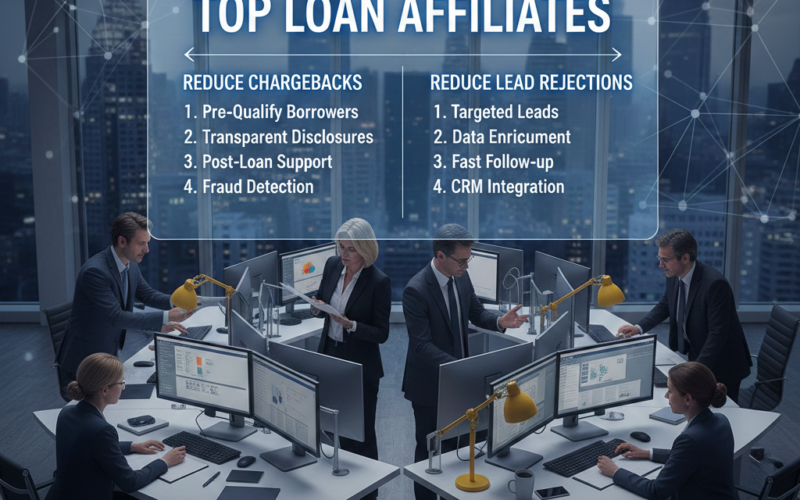
If you audit enough loan affiliate websites, a pattern becomes obvious very quickly. Most do not fail because traffic is impossible to get or because lenders are dishonest. They fail because the leads they send are weak, non compliant, or mismatched to the lender’s expectations. Chargebacks and lead rejections slowly kill the business before the site ever becomes profitable.
This article explains why most loan affiliate websites struggle or shut down within the first year and how experienced affiliates reduce chargebacks and rejected leads when running a personal loans affiliate program. Everything here comes from real audits, real traffic data, and real conversations with lenders and networks.
There are no shortcuts. There is no hype. There is only process, discipline, and patience.
Why Chargebacks and Lead Rejections Kill Loan Affiliate Sites Early
Most beginners underestimate how fast bad lead quality destroys momentum.
At the start, affiliates focus on payouts. They see a $100 or $150 per lead offer and assume a few conversions will cover costs. What they do not see is the silent damage caused by rejected leads.
Here is what usually happens in the first six months:
- Traffic is pushed too fast without qualification
- Leads look good on the surface but fail lender checks
- Rejection rates cross 30 to 50 percent
- Chargebacks start appearing after initial payouts
- Networks reduce caps or pause traffic
- Cash flow becomes unstable
- Motivation drops and the site is abandoned
This cycle repeats across almost every failed personal loans affiliate program.
The Biggest Myth: More Traffic Fixes Everything
One of the most damaging beliefs in loan affiliate marketing is that more traffic fixes low earnings.
In reality, more low quality traffic increases losses.
When affiliates send unqualified users, lenders see patterns very quickly. They track IP history, device fingerprints, application behavior, and completion signals. Even organic traffic can be flagged if intent is weak.
Experienced affiliates understand this early. They focus on fewer leads with higher acceptance rates rather than volume.
A site sending 50 approved leads per month often outperforms a site sending 300 leads with heavy rejection and clawbacks.
Common Reasons Loan Leads Get Rejected
Understanding rejection reasons is the foundation of fixing the problem.
Based on audits and lender feedback, most rejected leads fall into a few categories.
Mismatched User Intent
Many affiliates attract users who are researching, not applying.
Examples include:
- Informational blog posts with aggressive apply buttons
- Comparison pages without clear eligibility criteria
- Broad keywords like “loan help” or “borrow money”
These users click, submit partial forms, and drop off during lender validation.
Incomplete or Inaccurate Data
Lenders reject leads when:
- Phone numbers are invalid or VoIP based
- Emails bounce or are disposable
- Employment details are inconsistent
- Income fields are inflated or random
This often happens when forms are too short or unclear.
Geographic and Regulatory Mismatch
Loan rules vary by country, state, and even city.
Common mistakes include:
- Sending US traffic to state restricted offers
- Ignoring payday loan caps in regulated states
- Not filtering age or residency properly
These leads never had a chance to convert.
Incentivized or Misleading Funnels
Some affiliates promise things they cannot deliver.
Examples:
- “Guaranteed approval” language
- Claims of instant cash without checks
- Fake urgency or countdown timers
These tactics increase form fills but destroy lead quality and trust.
Why Most Personal Loans Affiliate Program Sites Fail in the First Year
Chargebacks are not the root problem. They are the symptom.
The real causes are structural.
No Understanding of Lender Risk Models
Beginners treat lenders like advertisers. They are not.
Lenders are risk businesses. Every lead is scored. When affiliates ignore this, rejection rates rise quickly.
Poor Funnel Design
Most early stage sites use:
- One page funnels copied from competitors
- No pre qualification
- No explanation of who should apply
This invites bad traffic.
Over Reliance on One Offer or Network
When chargebacks start, affiliates have no backup.
One pause or one account review can end the entire project.
Unrealistic Timelines
Many expect profitability in 30 or 60 days.
In reality, a stable personal loans affiliate program often takes 6 to 12 months to mature with organic traffic.
How Profitable Loan Affiliates Reduce Rejections From Day One
The difference between failing sites and profitable ones is not traffic source. It is discipline.
Here is what top affiliates do differently.
Step 1: Pre Qualify Before the Form
Experienced affiliates never send raw traffic directly to lenders.
They add a qualification layer.
This can be:
- Simple questions about employment status
- Income range selection
- State or location confirmation
- Credit profile clarification
This reduces bad submissions and sets correct expectations.
Even a single qualifying step can improve approval rates significantly.
Step 2: Match Content to Real Applicant Intent
Top affiliates separate content types.
They do not mix education with application intent.
Examples:
- Educational blog posts without aggressive CTAs
- Comparison pages clearly labeled as application ready
- Eligibility disclaimers placed before forms
This ensures users understand what they are doing.
Step 3: Be Honest About Approval Reality
This is uncomfortable for beginners but critical for survival.
Profitable affiliates clearly state:
- Approval is not guaranteed
- Income and employment matter
- State laws apply
- Lender criteria vary
Ironically, honesty increases trust and reduces junk leads.
Step 4: Design Forms for Accuracy, Not Speed
Fast forms attract bad data.
Experienced affiliates:
- Use validation on phone and email fields
- Avoid auto filled random values
- Explain why certain information is needed
- Space out form steps logically
Fewer but cleaner submissions protect long term revenue.
Step 5: Monitor Rejection Reasons Weekly
Most failing affiliates do not analyze rejections.
Top affiliates:
- Track rejection codes
- Ask networks for feedback
- Adjust funnels based on lender response
- Remove traffic sources that underperform
This feedback loop is continuous.
Why Chargebacks Still Happen and Why That Is Normal
Even the best personal loans affiliate program will see some chargebacks.
This is part of the business.
What matters is proportion.
Healthy benchmarks often look like:
- Approval rates above 60 percent
- Chargebacks under 10 percent
- Stable caps over time
- Increasing EPC rather than raw volume
When these numbers slip, adjustments are made immediately.
How Long It Really Takes to Build a Profitable Loan Affiliate Site
This is where many quit too early.
From experience, a realistic timeline looks like this:
- Months 1 to 3: Research, setup, early content, testing
- Months 4 to 6: Traffic growth, funnel refinement, early revenue
- Months 7 to 12: Stable rankings, lender trust, scaling
Sites that survive past the first year usually become assets.
Sites chasing quick wins usually disappear.
Why SEO Focused Loan Sites Have Lower Chargebacks
Organic traffic behaves differently from paid traffic.
SEO driven sites tend to:
- Attract higher intent users
- Allow longer educational content
- Build topical authority
- Reduce bounce driven submissions
This is why many profitable personal loans affiliate program sites focus heavily on SEO, even if growth is slower.
What Beginners Should Stop Doing Immediately
If you are starting or struggling, these changes matter.
Stop:
- Copying funnels without understanding them
- Promising outcomes you cannot control
- Sending traffic without qualification
- Ignoring lender feedback
- Measuring success only by clicks
Start:
- Thinking like a lender
- Designing for trust
- Measuring approval, not just leads
- Planning for a year, not weeks
Final Reality Check
Loan affiliate marketing is not easy, but it is not impossible.
Most sites fail because they treat leads like numbers instead of people and risk signals. Profitable affiliates succeed because they respect lender economics, build honest funnels, and optimize for acceptance rather than volume.
If you approach a personal loans affiliate program with patience, compliance, and long term thinking, chargebacks become manageable instead of fatal.
The difference is not luck. It is execution, consistency, and realistic expectations.