




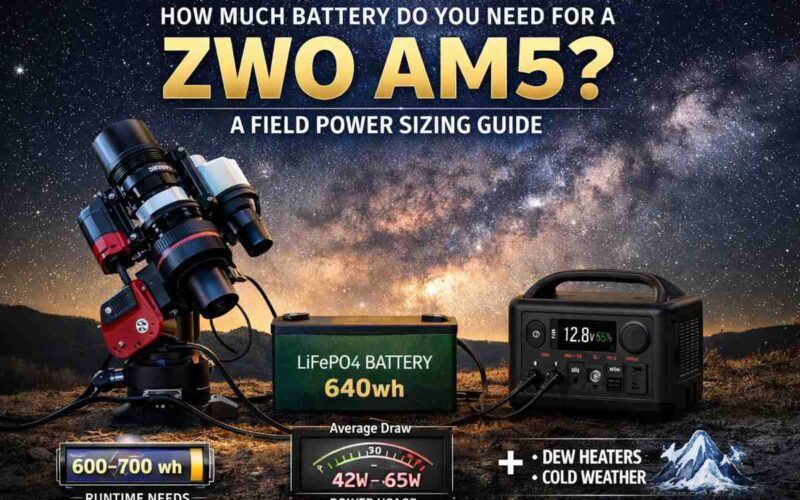
One of the most liberating moments for an astrophotographer is moving away from the backyard mains and into the wild. The ZWO AM5 is the perfect partner for this, offering a lightweight, counterweight-free experience that practically begs to be taken to a dark-sky site. However, that freedom comes with a mathematical catch: you are now your own utility company.
The question I am most frequently asked by those moving to a strain-wave setup is: “How much battery do I actually need for a full night?” To answer that, we have to look past the marketing “max ratings” and calculate the real-world hunger of a modern imaging rig.
Understanding the AM5 Power Profile
The beauty of the ZWO AM5 lies in its efficiency. Unlike traditional heavy-duty mounts that use significant power just to move their own mass, the AM5 is remarkably frugal.
- Standby/Idle: ~0.4A (approx. 5W)
- Sidereal Tracking: ~0.7A (approx. 8.4W)
- GOTO/Slewing: ~1.7A to 2.0A (up to 24W)
On average, the mount itself is only drawing about 10 Watts during a standard imaging session. If you were only powering the mount, a tiny talentcell battery would last you all weekend. But we aren’t just running a mount; we are running a mini observatory.
The “Full Rig” Calculation
To size your battery correctly, you must sum the average draw of every component connected to your ASIAIR or power box. A typical “prosumer” AM5 rig might look like this:
| Component | Average Draw (Watts) | Amps (at 12V) |
| ZWO AM5 Mount | 10W | 0.83A |
| ASIAIR Plus / Mini PC | 5W – 8W | 0.6A |
| Cooled Main Camera (e.g., ASI2600MC) | 15W – 25W | 1.2A – 2.0A |
| Guide Camera & EAF | 2W | 0.16A |
| Dew Heaters (Essential in the UK!) | 10W – 20W | 0.8A – 1.6A |
| Total Average Draw | 42W – 65W | 3.5A – 5.4A |
In this scenario, your rig is likely pulling between 500Wh and 650Wh over a standard 10-hour winter night in the UK.
Choosing the Right Battery Technology
Not all “Amp-hours” are created equal. When looking through catalogues of telescope stores in the UK, you will encounter three main battery types:
- Lead-Acid/AGM: Avoid these for portable AM5 rigs. They are incredibly heavy and you can only safely use about 50% of their rated capacity before the voltage drops too low for the AM5’s sensitive electronics.
- Lithium-Ion (Li-ion): Common in “portable power stations” like Jackery or EcoFlow. These are excellent, lightweight, and usually offer a 12V regulated output which is critical for preventing the mount from “beeping” due to undervoltage.
- LiFePO4 (Lithium Iron Phosphate): This is the gold standard. They are safer, last for thousands of charge cycles, and maintain a very flat voltage curve (around 13.2V) until they are nearly empty.
The Golden Rule: The 20% Buffer
When calculating your needs, always add a 20% safety margin. If your rig requires 500Wh for a 10-hour session, do not buy a 500Wh battery. Cold temperatures significantly reduce battery efficiency; on a freezing night in the Peak District, a battery might only deliver 80% of its rated capacity. For a “full night” (8-10 hours) with a cooled camera and dew heaters, a 600Wh to 700Wh power station is the sweet spot.
Expert Tips for Power Management
- Beware of Inverters: If you use a portable power station, do not use the AC plug (the 3-pin UK socket). Converting 12V DC to 230V AC and then back to 12V via a “wall wart” is incredibly inefficient and can waste up to 20% of your power as heat. Always use the 12V DC (cigarette or 5.5mm) ports.
- Voltage is King: The AM5 can operate between 11V and 15V, but it is much happier at the higher end. If your battery drops to 11.5V, the mount may stall or lose its connection to the ASIAIR. A “regulated” 12V or 13.8V output is highly recommended.
- Dew Heater Duty Cycle: Use a controller (like the one built into the ASIAIR) to manage your dew heaters. Running them at 100% all night is the fastest way to kill a battery. 25-50% is usually more than enough for British humidity.
Final Verdict
If you are building an AM5 rig for serious field work, look for a 50Ah (approx. 640Wh) LiFePO4 battery or a mid-sized portable power station. This provides enough “grunt” to run a cooled camera and dew heaters through a long winter night with enough headroom to ensure your mount never loses its tracking.
Being over-powered is a minor inconvenience of weight; being under-powered is a night of lost data. Plan for the cold, plan for the dew, and your AM5 will track flawlessly until the sun comes up.