




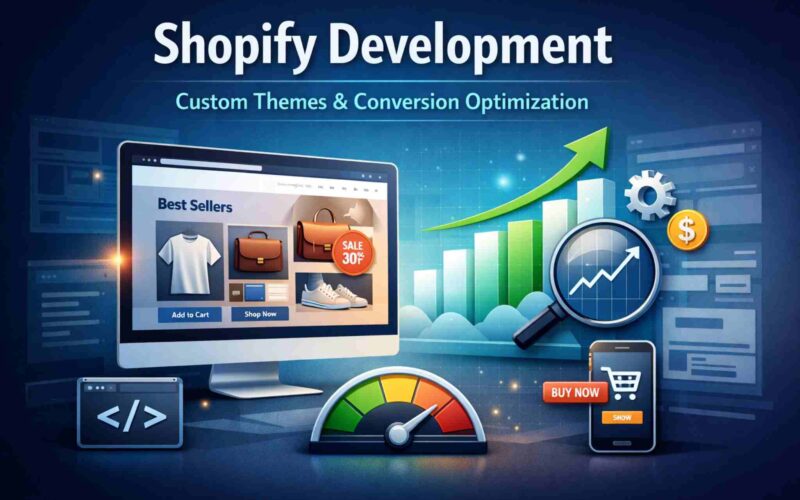
A working Shopify theme vs. a laser-targeted, high-converting at-scale Shopify theme is an entirely different creature altogether! Shopify Theme Store templates are almost all built well. They load fairly quickly, they render decently and they work. However, they’re made for the largest possible audience, which means that nobody in particular gets an optimized version of them.
The gap is bridged with custom theme development, which creates a storefront customized for your customers, your products, your conversion goals and the essence of your brand. For brands operating at scale, that specificity has a direct correlation to revenue.
The Performance Case for Custom Themes
Stores built on custom themes by skilled Shopify custom theme development experts consistently outperform template stores in the Core Web Vitals metrics. The explanation is simple: custom themes only include the codes that your store needs to function properly. Templates come with dozens of features you will never use, and every unused line of CSS and JavaScript will slow your store down without giving you anything in return.
The difference in performance is quantifiable and significant. Custom themes perform 40–60% faster than template-based stores with equivalent design complexity (measured by LCP). On mobile, where users are more intolerant of slow load times and much more likely to abandon pages which load slowly, this leads directly to lower bounce rates and higher conversion rates.
The revenue impact performance brings for enterprise brands using Shopify Plus is significant. Research has shown time and time again that for every 100 milliseconds a page loads faster, conversion rates go up by roughly one percent. If you are a brand earning $20 million per year, getting rid of 500 milliseconds from your load time can lead to an additional $1 million in sales. This is not theoretical. This kind of revenue uplift is consistently reported by brands who invest in custom themes for performance gains.
Architecture Decisions That Matter
The most excellent custom Shopify themes take advantage of Online Store 2.0 architecture, so you can do section-based editing for each page type, not just the homepage. This provides your content and marketing teams the power to update pages without developer pain points that slow you down, increases speed of content velocity, and frees up your dev team for more impactful work.
Choosing JavaScript architecture is a crucial decision that affects performance and maintainability. In 2026, the pendulum has swung towards minimal JavaScript and scoped interactivity. The fastest and most redundant storefronts are made using progressive enhancement, where pages work without JavaScript and increase in functionality with its usage. Web Components and light-weight frameworks like Alpine. js, or Petite Vue have come to replace heavier alternatives for Shopify theme development, producing interactivity without the performance cost of larger frameworks.
Over the last year, CSS architecture has become something of a controversial subject in web agencies. The use of utility classes or a component-based approach enables a well-structured CSS system, reducing specificity conflicts and making files smaller while ensuring maintenance is considerably easier in the future. The single biggest source of technical debt within Shopify themes comes from poorly structured CSS, resulting in slower and slower sites as styles accumulate over months and years.
Working with the Right Development Partner
Choosing a Shopify development agency for customized themes is not just about design and technical skill sets. Lighthouse scores on recent builds? Ask them for sample code from recent work. Question them with their processes right from accessibility, responsive design to JavaScript performance and CSS architecture. The answers to those questions tell you whether agencies build with care or just make things work.
The very best custom theme developers have opinions about architecture. They know exactly what they like when it comes to CSS methodologies, JavaScript approaches, section structure, and code organization. And this opinionated approach yields better results than agencies that acquiesce to every whim of the client without pushing back against bad choices. You want a development partner with expertise and best practices, not one who just implements what you asked for.
The Investment and Returns
Typically you are looking at a $40k to $120k investment for custom Shopify theme development depending on the richness of the theme features and functionality, the rates of the agency that is developing it for you, as well as any 2+ level down integration (3rd party API calls) with custom features. Returns come as a results of higher conversion rates, better page speed scores aiding your search engine optimisation performance, lower ongoing developer costs due to having a clean codebase and the offering of a unique brand experience which is distinct from competitors using the same templates.
Custom theme development is the highest-ROI investing for brands doing over $5mm a year in revenue. Performance improvements, conversion wins, and brand differentiation yield a return on investment that dwarfs the upfront development costs in a year. And unlike marketing spend, which runs dry if you stop spending, a quality custom theme keeps on giving value years later.
Long term maintenance benefits are equally important. A clear and well-organized custom codebase can be easily maintained, extended, and changed over time far more simply — and often for less money — than trying to deal with a heavily modified template that is covered in layers of customizations, app injections, hacks, cobbled together hacks. The development velocity on a clear codebase is usually 2-3 times quicker than that of a modified template, meaning every feature/fix/optimization in the future are cheaper to create and ships faster.
When to Invest in Custom vs Template
The decision between custom and template development should be driven by data, not ego. If your current template-based store is converting well, loading fast, and supporting your growth, there may not be a compelling case for custom development yet. Focus your budget on marketing and customer acquisition instead. Custom development becomes the right investment when your template is limiting your performance, constraining your brand expression, or creating ongoing maintenance costs that approach or exceed the cost of building custom.
For brands considering what the best approach is for their Shopify development, the answer depends on your revenue, your growth rate, and your competitive landscape. Under $2 million in annual revenue, templates are almost always sufficient and allow you to focus resources on growth. Between $2 million and $10 million, evaluate whether your template is creating bottlenecks that custom development would resolve. Above $10 million, custom theme development is nearly always the right choice, as the performance and brand differentiation benefits generate returns that justify the investment many times over.
The brands that get the best results from custom theme investment are those that treat it as the beginning of an ongoing optimization process, not a one-time project. Custom themes provide the clean foundation that makes continuous improvement possible, and the brands that pair great initial development with ongoing optimization consistently outperform those that build once and let the store stagnate.